
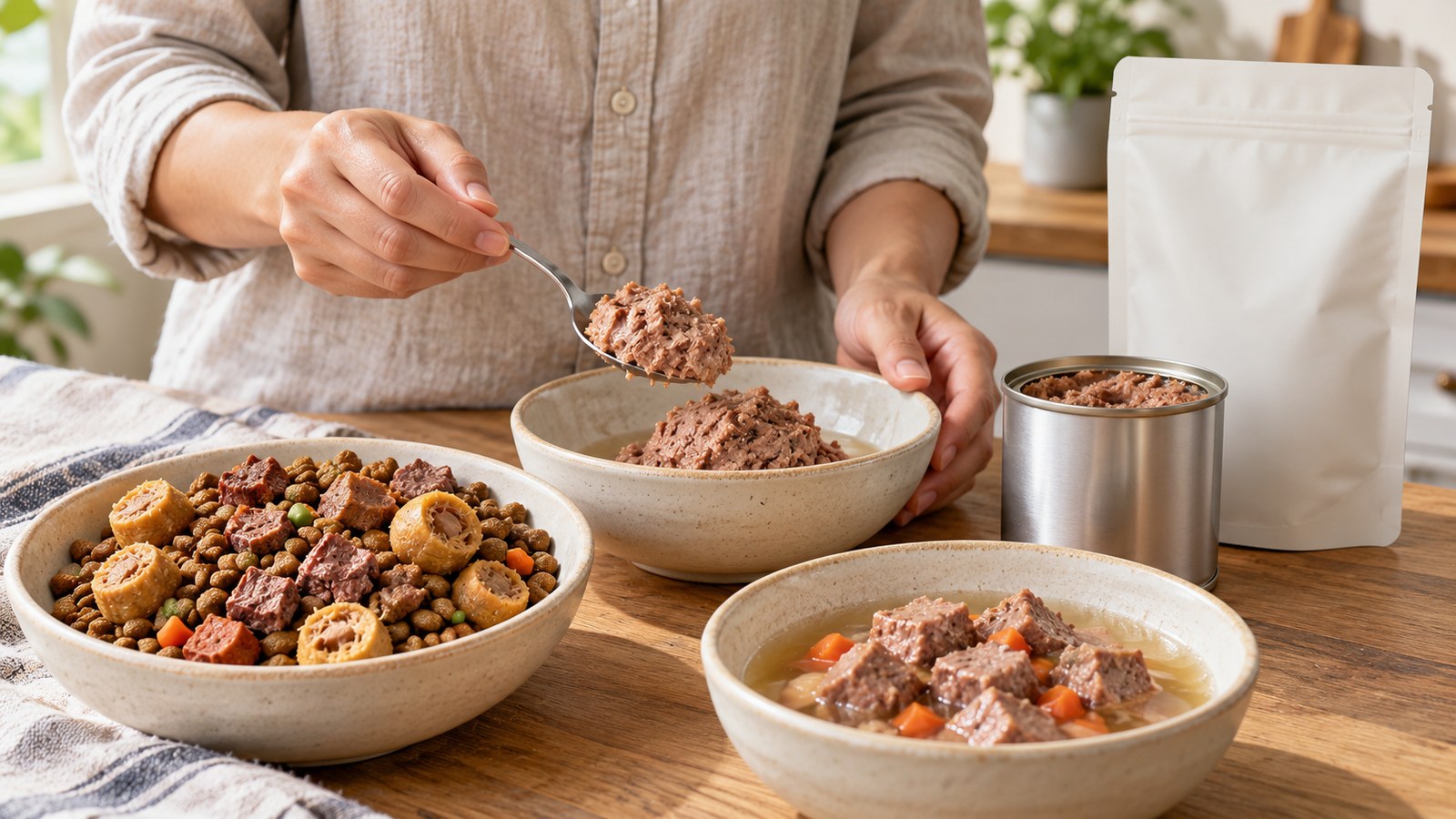
To work out how to start a dog food brand, define your product, choose a manufacturing route, and confirm registration and labeling requirements before committing to a commercial order. For retailers, distributors and new brand owners, contract manufacturing is a practical starting point; self-manufacturing makes sense when operating a production business is part of the plan.
Dog Food Brand Launch Steps
Start with an existing formula when it fits your product brief; choose custom development when the recipe is central to your offer. In either case, settle the destination market, product purpose and manufacturing responsibilities before approving packaging or committing cash to the first commercial order.
- Define your buyer and food format.
- Choose an existing formula or custom development.
- Check registration and labeling requirements.
- Vet the manufacturer and agree responsibilities.
- Review samples and supporting evidence.
- Approve packaging and artwork.
- Place the first order and plan replenishment.
1. Define Your Dog Food Positioning and Format
Choose a product your intended sales channel can support. A retailer adding its own food range should begin with the needs of its existing customers. A distributor should define the product specifications and packaging its downstream buyers need before discussing formulas.
Write down the intended dog life stage, feeding purpose, food format and destination market. Decide whether you’re developing a complete diet or a product intended to accompany other food. Record that intended feeding role in the formulation brief.
At FreshBite, we manufacture dry and wet cat and dog food. Keep food format and feeding purpose as separate entries in your product brief.
2. Choose Your Formula and Manufacturing Route
Use an existing formula if it meets your intended product specification. Custom development is justified when you need changes to the formula, texture or nutritional composition that an available recipe doesn’t provide. Define those requirements before comparing quotations.
For either route, clarify the recipe, product specifications, packaging and scope of services.
| Launch route | Starting point | Questions to settle before committing |
|---|---|---|
| Existing-formula private label | An available recipe | What product specifications, recipe adjustments and packaging options are available? |
| Custom contract manufacturing | Your recipe or a development brief | What development services, product specifications and packaging work are included? |
| Self-manufacturing | Your own production operation | Which requirements apply to the facility, product and production activities? |
Our private label solutions include available recipes and custom development. Use your brief to confirm which development and packaging services the quotation covers.
3. Establish Your Dog Food Regulatory Requirements
In the United States, the Food and Drug Administration’s startup guidance explains that animal-food businesses may face FDA, other federal, state and local requirements. The requirements that apply vary with the type of animal food and the business’s activities.
Check the requirements for the jurisdictions where you will operate and sell, taking account of the food type and your planned business activities.
4. Vet Your Dog Food Manufacturer
Choose a manufacturer around the product you intend to sell. A useful first discussion should establish whether the business can produce the required format, work with your formula route and provide the information needed for your destination market.
When comparing private label pet food manufacturers, use the same product brief for every candidate. Otherwise, differences in recipe, pack size or included services can make quotations difficult to compare.
Prepare these details before making contact:
| Have ready | Include |
|---|---|
| Target market | Countries and, where relevant, states where you intend to sell |
| Product purpose | Dog life stage and intended feeding role |
| Formula direction | Existing recipe, custom development or a formula you provide |
| Food format | Dry or wet, with the desired texture |
| Packaging brief | Pack format, proposed fill weight in g or kg, and SKU count |
| Commercial plan | Sales channel, intended order quantity and target launch window |
Ask what specifications and services are included, which tests and records are available and who provides them, and whether ingredient substitutions are allowed and within what limits.
Ask about arranging a factory visit or video tour to discuss your product and packaging brief.
5. Review Samples and Supporting Test Evidence
Ask whether samples will be supplied before the first production run. Evaluate their appearance and texture against your product brief.
For our extruded and baked kibble, sampling typically takes 7–14 working days once the product direction is agreed. Agree commercial delivery dates and sampling schedules for other formats separately.
For sample review, ask which tests and records will be provided for the finished food and how the samples will be assessed. If nutritional or caloric analysis is needed, contact a laboratory that analyzes pet food for instructions on preparing and shipping the sample.
6. Approve Dog Food Packaging and Labels
Agree the packaging structure before completing artwork. The selected pack needs a defined fill weight and dimensions so the designer can work on the correct layout.
At FreshBite, we provide packaging structure suggestions; your brand supplies the packaging artwork. Our wet-food manufacturing includes a Tetra Recart carton line, which is relevant when you’re considering carton-packed wet food.
Review the label information and proposed claims against the destination market’s requirements before finalizing the artwork.
Review the website description alongside the pack. Promotional wording also needs attention, especially if the website makes claims that don’t appear on the physical label.
For export projects, FreshBite provides health, sanitary and origin certificates. List the destination’s required documents separately from the label approval so both are ready for the shipment.
7. Plan Your First Order and Reorders
Choose the opening range before evaluating minimum order quantities. Each proposed formula, SKU and pack format belongs in the quotation request. A single headline MOQ won’t tell you the commitment required for a range with several variants.
FreshBite quotes MOQ according to product type, formula, SKU count and packaging format. Compare quotations against the same specification, and identify whether development, testing, packaging and delivery are included or priced separately.
Build your launch budget from the actual scope:
- Formula development and samples.
- Relevant testing and regulatory work.
- Food production and packaging.
- Freight, storage and fulfillment.
- Sales-channel fees and launch spending.
Separate one-time launch costs from costs that recur with each order. Calculate what each sale leaves after its product and selling costs, then check whether that contribution can cover operating expenses. Use the sales price you expect to receive through your chosen channel.
Before ordering, put the product specifications, packaging artwork, quantities by SKU, payment terms and delivery schedule in writing. Confirm reorder terms, including lead times for subsequent deliveries.
Plan replenishment from stock on hand, actual sales and the agreed supply schedule. Expand the range when you can support the next inventory commitment, rather than adding variants simply because they’re available.
FAQ
What is the 95% dog food rule?
For “Beef Dog Food,” AAFCO’s U.S. model naming rule requires beef to make up at least 95% of the product’s weight excluding added processing water, and at least 70% including that water. These thresholds concern ingredient weight for naming, not protein percentage.
Is selling dog food profitable?
A launch is profitable only when revenue exceeds production, delivery, selling and operating costs. Plan for the possibility that supplier bills or reorder funding fall due before customers pay.
Which pet business is most profitable?
For startups, compare setup costs such as equipment and premises, plus working capital needed before sales cover bills; retailers should compare added contribution after product and selling costs with cash tied up in inventory. A sector ranking depends on your sales, cost and capital projections.
Do you need a dog food permit?
Selling dog food may require registrations or approvals, depending on jurisdiction, product and business activities. In the UK, processing animal by-products into pet food requires Animal and Plant Health Agency (APHA) approval.
Before requesting a quotation, complete the product brief above and mark which decisions are fixed and which remain open. Explore our private label pet food products to identify the format you want to develop, then build the manufacturing discussion around that specific product.